Car Hire in Lanzarote: Excess, Deposit and What Gets Added at the Counter
Updated October 1, 2026 · 12 min read
The short answer: on Lanzarote, the excess usually isn’t your problem. The two long-established Canarian firms, CICAR and Autoreisen, publish fully comprehensive cover with no excess, and Autoreisen takes neither a cash deposit nor a credit card pre-authorisation. What actually catches you out here is a clause: Autoreisen forbids driving on unsurfaced roads — and that’s exactly what the access road to the Papagayo coves is. Anyone who wants to see the lava tracks without driving them lets someone else do the driving: the 4x4 Volcanic & Coastal South Adventure costs €68 per person for six hours and includes free time at Papagayo beach.
See availability and prices for the 4x4 Volcanic & Coastal South Adventure
Car hire in most of Europe works like this: a low daily rate, a large excess you only notice at the desk, and a four-figure hold on your credit card that clears some weeks after you get home. The Canary Islands are the exception, and it is the single most useful thing to know before you book anything in Lanzarote.
That does not mean there is nothing to check. It means the things worth checking are different ones.
What “excess” actually means
The excess is the amount you pay yourself if the car is damaged or stolen, before the damage waiver covers the rest. CDW — collision damage waiver — is not insurance in the ordinary sense: it is the rental company agreeing not to charge you beyond that figure. A contract that says “CDW included” and then names an excess still exposes you to the whole of that named amount, and a scraped bumper usually costs less than it, which is why the excess is the number that gets paid in practice.
Which is why the wording on the two long-established Canarian firms matters so much. CICAR states that “the insurance is fully comprehensive without excess”, and that the price includes taxes and unlimited mileage. Autoreisen lists collision damage waiver, theft protection and third-party damage with the line “no excess amounts are required”. On those contracts the figure you are exposed to for ordinary bodywork damage is zero, not reduced.
If you book through a broker instead, read the excess in your own booking rather than assuming. It is a number, it is written down, and it is the number that decides whether the extra cover sold at the desk is worth anything.
The deposit, and the island’s unusual answer to it
The deposit is separate from the excess. It is money blocked on your card as security, and it is the part that surprises people, because a hold you cannot spend is indistinguishable from money you no longer have.
Autoreisen states plainly: “We do not require any cash deposit, or credit card pre-authorization.” CICAR’s published conditions name only one deposit at all — a fuel deposit, taken when the contract is signed for the amount of fuel in the tank and returned if you bring the car back with the same amount. Ask at the desk whether anything else is blocked; an absence in a published summary is not the same as a promise.
Now the contrast, because it is the reason this article exists. Book through an international broker and the supplier’s own rules apply. Discover Cars, our car hire partner, is explicit that its Full Coverage is a reimbursement product from Discover Cars, not from the rental company — you still leave the supplier’s deposit at the desk, then claim back what you paid. Its help centre says the deposit amount depends on the car category and the local supplier, that the accurate figure is in the Rental Conditions attached to your own booking, and that the hold typically releases within 21 business days after you return the car.
Three weeks is the number to plan around. If the deposit would be a problem on your card, that is the reason to look at a firm that does not take one. Compare what the different suppliers on the island ask for — the deposit is shown in the conditions of each offer, not only the price.
What gets added at the counter
Fuel. Neither of the two firms above uses the full-to-full model most of Europe runs on. Both use same-level: bring it back as you got it. CICAR blocks a fuel deposit for the tank’s contents and refunds it; Autoreisen charges for what is missing. Photograph the gauge when you collect the car.
Child seats. Both firms include baby seats and booster cushions free of charge. CICAR’s free seats are a 0–18 kg rear-facing or forward-facing seat and a 15–36 kg backless booster, and the customer fits them; Autoreisen includes approved seats and boosters but charges €5 a day, up to €45, for ISOFIX models. If you need ISOFIX, book it when you book the car — it is a line item, not a favour.
Second driver. Free at both. Add them at the desk, with their licence present.
The upsell that is actually narrow. Autoreisen sells Comfort Plus at €2 a day up to a maximum of €30, covering lost keys, wheel rim damage, tyres, wrong fuel and a flat battery. Notice what those five items have in common: they are the things a zero-excess waiver does not cover. That is what extra cover is for here — not the bodywork, which is already handled.
Age, licence and the paperwork
CICAR: minimum age 21. Autoreisen: does not rent to drivers under 23. Both require a licence valid in Spain and held for at least two years. Those are two different thresholds at two firms on the same island, so check the one you are booking rather than the one you read about.
If you hold a UK photocard licence, the UK government’s guidance is that no international driving permit is needed to drive in Spain — carry the licence itself. Your hire company may want to see your licence record, which UK drivers share with a DVLA check code valid for 21 days. Generate it shortly before you travel, not in January for an April holiday.
What no waiver covers — and this one catches people in Lanzarote
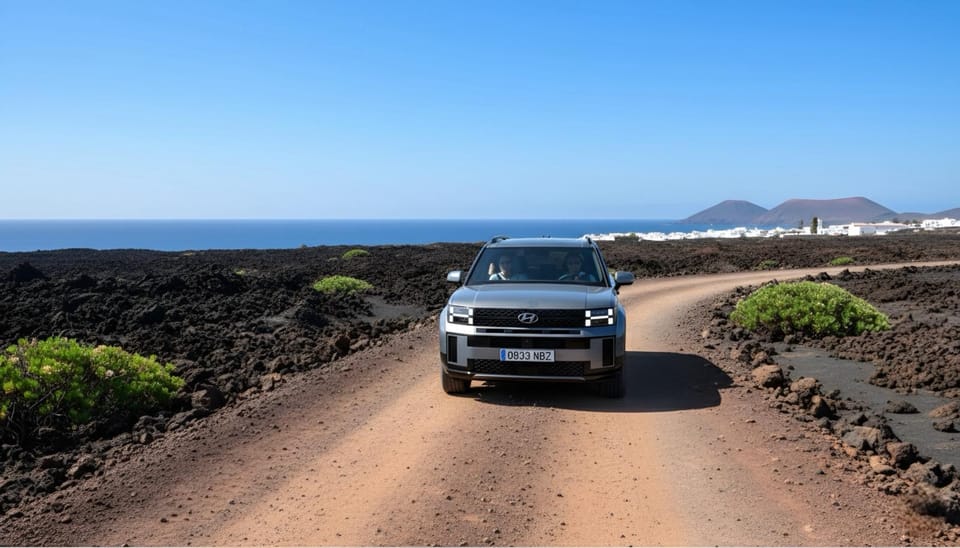
Autoreisen’s conditions prohibit driving on unsurfaced roads, or on roads whose condition could damage the underside of the car. Read that next to your holiday plan, because the access road to the Papagayo coves is exactly that: a graded dirt track with a €3 barrier per car, and the most-driven unpaved road on the island. We cover the approach in how to reach the Papagayo coves, and the short version is that a zero-excess contract can still leave you paying for the damage, because the clause takes you outside the cover entirely rather than reducing it.
The second clause worth reading: the vehicle must not leave the island on which it was hired without specific written authorisation. If a day trip to Fuerteventura is in your plan, take the ferry as a foot passenger, not as a driver.
If you still want to see the tracks: let someone else drive
The clause forbids you the track, not the destination. Anyone who wants to see the lava tracks, Papagayo or the Famara north coast books a guided drive in the operator’s own vehicle – then the surface is their problem, not yours. Four guided drives compared:
| Guided drive | Duration | from | Rating | Best for |
|---|---|---|---|---|
| 4x4 Volcanic & Coastal South Adventure | 6 hours | €68 per person | 4.3 (98) | Anyone who wants to see Papagayo and El Golfo without taking their own hire car onto the track |
| 4x4 Volcanic North Landscapes Adventure | 6 hours | €68 per person | 4.9 (17) | Anyone who prefers Teguise, the Famara coast and the northern viewpoints |
| La Graciosa Complete Jeep Tour with Beach Time | 2h 30m | €55 per person | 4.4 (176) | Day visitors to La Graciosa, where there are no paved roads anyway |
| Guided Off-Road Volcano Buggy Tour | 2 - 3 hours | €150 per buggy for up to 2 people | 4.7 (5,361) | Couples who want to drive themselves – though in the operator’s buggy |
The first three are prices per person, the buggy is charged per vehicle. All four are under Buggy and quad or Timanfaya volcano tours.
See availability and prices for the 4x4 Volcanic North Landscapes Adventure
The line on your bill that looks wrong but is not
Your invoice will show IGIC at 7%, not Spanish IVA at 21%. The Canary Islands have their own indirect tax system, and 7% is its general rate. It is correct, it is not a discount someone will claw back, and it is one of the reasons hire on these islands prices the way it does.
Before you sign
- Read the excess figure in your own booking; zero is normal here but not automatic through a broker.
- Read the deposit in the Rental Conditions of the specific offer, and reckon on a hold of up to about three weeks if there is one.
- Check the minimum age for the firm you have chosen: 21 and 23 both exist here.
- Photograph the fuel gauge and the bodywork before you drive off, including the wheels.
- Book ISOFIX in advance if you need it.
- Accept that the unsurfaced roads clause is real, and decide about Papagayo before rather than after.
Then take the keys. On an island where the good cover is the default rather than the upsell, the remaining risk is mostly the part you drive onto yourself.
Our recommendation
For most people, it is worth looking at the Canarian suppliers: a contract with zero excess and no card hold saves you the upsell at the counter. Compare the suppliers on the island and their conditions, and read the deposit along with it, not just the daily rate.
Anyone who wants to see the lava tracks and Papagayo books the 4x4 Volcanic & Coastal South Adventure for €68 per person. Six hours, the surface is the operator’s problem, and you risk no clause. It is no good for people who want to stop and change plans themselves along the way – for that, a hire car on the paved roads is the better choice.
Anyone who wants to drive themselves takes the guided off-road volcano buggy tour for €150 per buggy for up to two people. With 5,361 reviews it is the most widely reviewed off-road excursion on the island, but a buggy is not the right vehicle for a family day out with luggage.
CICAR’s and Autoreisen’s published rental conditions, Discover Cars’ help centre and UK government guidance on driving abroad are the sources for this article. Terms change, and the conditions attached to your own booking are the ones that count.